
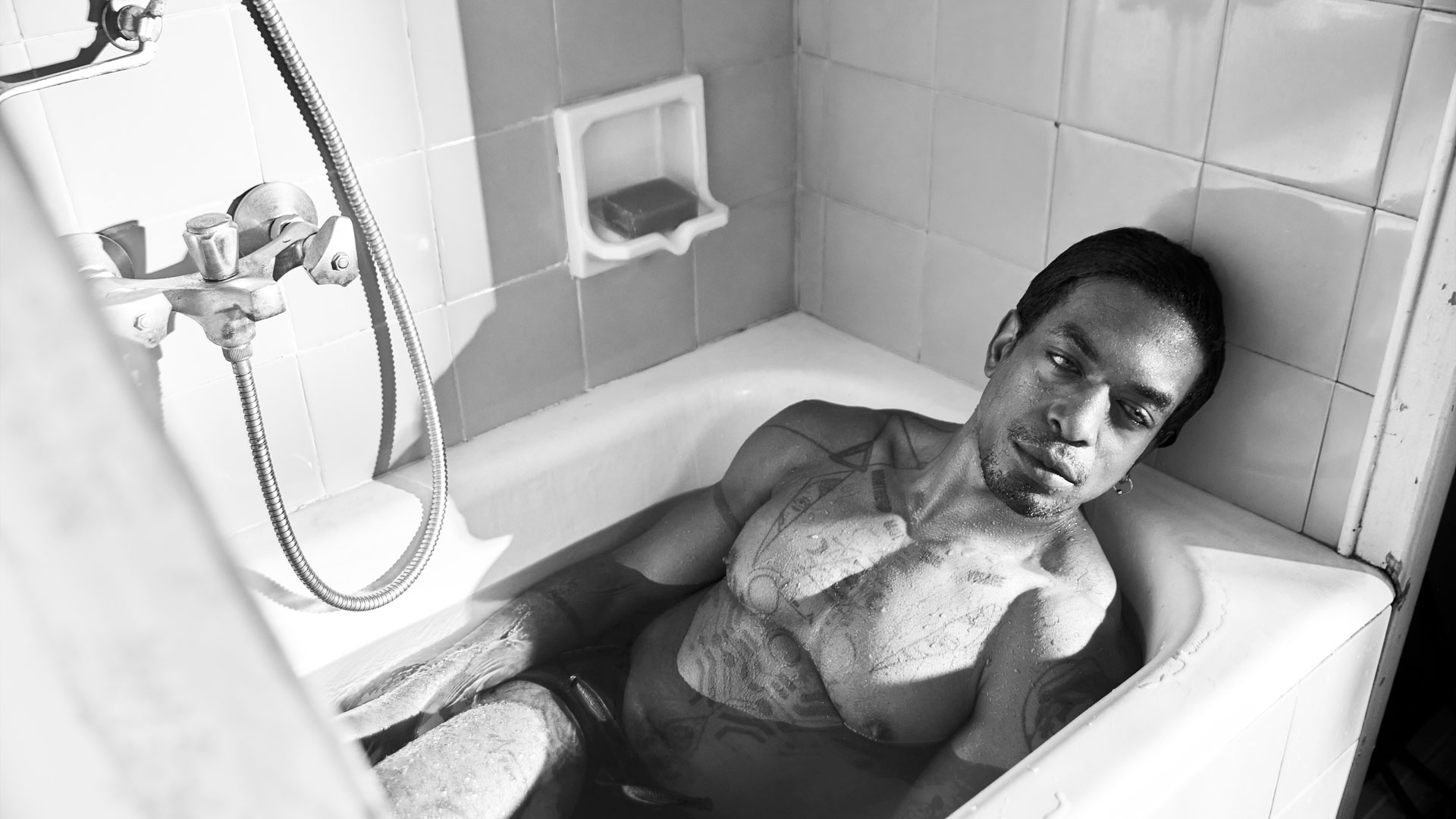
In recent years, a certain form of leisure has become more and more popular in the gay scene as a fast track to connection and disinhibition. I’m talking about chill sessions and extended after-hours gatherings where substance-fueled sex plays a central role. It’s an extreme form of hedonism in which the ultimate goal is not just pleasure—it often seeks to silence loneliness and pause the self-inflicted pressure on our bodies and our emotions. It’s a temporary escape from the worries of our daily lives.
This phenomenon has grown to the point of becoming structural. What used to be a marginal practice is already shaping our relationships, our bodies, and the very perception of who we are. With RAID, I wanted to create space for an honest conversation about this matter, showing the full spectrum of feelings that it conveys.
Today, I’m releasing the digital download of the final episode of this four-part series. With this last chapter, RAID comes to a close, not as a set of answers, but as an invitation to pause, to feel, and to reflect on what we seek, what we escape, and how deeply we long to connect.
Representation vs. celebration
Adult cinema rarely explores serious topics such as this one. And even when it does, it often limits itself to portraying behaviors rather than proposing a discourse or a conflict. With RAID, I wanted to integrate explicit sex within a critical and human narrative: people desperately trying to connect, seeking to numb emotions through chemistry and physical pleasure. This behavior can carry emotional and existential consequences, and RAID proposes the tool of explicit cinema as a means to explore the matter from an ethical and affective perspective, not a celebratory one.
That’s why I chose not to show the direct consumption of hard drugs. I wanted to avoid any reading of inducement or glorification. Also, payment platform restrictions come into play. The solution was to show the consumption of substances in a metaphorical and figurative way. This protects the meaning of the work and defines its position: not to instruct, not to normalize, but to represent.
Filming a wide spectrum of feelings
Silence, discomfort, and the “after”—these feelings are the core of the film. Silences reveal feelings that cannot be hidden away with substances. The sense of discomfort exposes the limits of the body as refuge. And the “after” confronts characters with their exhaustion, shame, isolation, and the impossibility of maintaining the illusion of careless joy.
The feelings of exhaustion, loneliness, and disconnection can be seen throughout the film: in the gestures of the characters, in the stiffness of their bodies, in the avoidance of eye contact or in the mechanical repetition of their physical interactions. Sex is performed as an attempt to quickly repair or silence these feelings, but instead it exposes a deeper sense of loneliness that does not disappear that easily.
“This phenomenon has grown to the point of becoming structural. What used to be a marginal practice is already shaping our relationships, our bodies, and the very perception of who we are.”
An open conversation
RAID seeks to portray the practice of chemsex in all its dimensions: the aesthetic pressure, the hook-up culture, the affective precariousness, and the need for a sense of belonging. The film observes without judging. It doesn’t condemn and it doesn’t idealize. It shows beauty where it’s due, but it also exposes the fragility that follows the ecstasy. I wanted to represent the process, the fractures, the costs, the silences, and the “after”. Here, the camera is a silent witness, allowing the viewer to see everything as it is and form their own opinions.
People who participate in these dynamics might ask themselves whether they’re doing it as a conscious decision or whether it sometimes feels like it’s the only option. Addiction is hard enough as it is, we don’t need to add blame to it, but rather offer support and alternatives to loneliness. Also, those who are comfortable partaking in these practices might also look at things with more awareness.
The wider context of RAID
RAID also happens within a historical tendency of the gay community being marked by plagues, persecution, and mechanisms of control: from HIV and its social scars, to police repression in leisure spaces. And today, once again, under the shadow of the resurgence of fascism.
Towards the end, a repressive force crashes the party, wearing uniforms that deliberately evoke the Francoist police force in Spain. It doesn’t try to be a literal element, but a symbolic one. It reminds us how queer bodies have repeatedly been singled out by the people in power and thrown into a sheepfold, like lambs guarded by the wolf. Following this, we see the completed funeral wreath with the message “we will always be in your hearts,” a poetic twist and a homage to those who are still alive and carry feelings of grief, marginality and erosion caused by consumption and loneliness.
RAID proposes reading this not as a moral condemnation, but as a lucid and compassionate warning about the fragility of the collective in the face of external forces in power.
Warm regards,


There are no reviews yet.